Manila FAME 2012

October 20, 2012

Today, October 20, was the last day of Manila F.A.M.E.

The show this year was very interesting and exciting. We felt pride as we went around and saw the different designs that each booth offered. The whole place was oozing of creativity, originality, and world-class quality. On top of all of these, one of the major themes of this year’s show was to integrate and showcase our Filipino culture everywhere in the venue, while infusing contemporary ideas and interpretations with it. The after effect of this will surely be amazing, as some form of ‘culture revival’ is taking place in the design industry and will surely be wide spread right after F.A.M.E. Filipinos (who usually long for Western culture) will now realize that cultural manifestations of our nation, if interpreted in contemporary way, will attain a renewed identity – something that can definitely compete globally.

Here are some snapshots of our rounds.

Manila FAME, curated by my friend Ito Kish!


The Gregoria, by Ito Kish. Last year's winner for best furniture design. The piece is a tribute to his mom. Fabulous in actual!


A new release by Ito Kish too. Spin-off floor lamp from the Gregoria.

A tesselated lamp design from Robles Heritage made in Capiz. Interesting!


Color seems to be popping up more now.

Center Table by Vito Selma


Nikki Boncan-Buensalido, with batchmate Charisse Ong and Vito Selma

Jason Buensalido with Charisse Ong and Vito Selma

Fabric Designs by Inigo Elizalde for Catalina Embroideries Cebu. Notice how the designs are reminiscent of traditional Filipino weavings. We bought a few for ourselves!

Aktiv Sports – Eastwood

October 20, 2012

storefront

"all great artists sign their work" - steve jobs

A few months ago, we were comissioned by the Relzbach Group to do a re-vamp of their store. Aptly called AKTIV, its a brand they developed that carries multiple brands under their wing such as Gola, New Era, Hunter, and Buff, among others.

Given all of these multiple brands with identities of their own, the real challenge was how to make the store look harmonious with all of these brands that have their own identities. Our solution was simple – to develop a module that could function in multiple ways as well, so that it could adapt to the specific need of each product. We started with a display shelf whose dimension was based on a shoe – this box is stackable to display multiple shoes, or be adjusted in dimension, to display products with differnet sizes such as bags and shirts. These boxes were also used as light shelves, to illuminate products that are far from the source of light in stores which is usually the ceiling. The boxes could also be used as signage bands – and with this, a certain visual organization was achieved as even if their logos and signages looked different from each other, the similarity of the module size and configuration that houses these logos are the same.

These modules were then rotated in such a way that it faces the storefront for premium visibility, stacked on each other, to form these “toblerone” shaped display modules (as the client fondly called it), that create an even bigger module collectively formed by the boxes. Sort of like an picture (toblerone) formed by pixels (boxes).

Being a store that focuses on an active lifestyle, we wanted to simulate the spirit of movement. By stamping these toblerone shaped modules throughout the perimeter of the store, a certain rhythm was achieved thru repetition, creating a visually appealing and dynamic atmosphere.

The choice of materials presented much difficulty during construction because of the absence of veneers. Concrete is seen as concrete. Metal is presented as metal. We wanted to achieve a certain kind of rawness in the interiors – the same kind of rawness people feel when they’re active. Call it visual honesty.

the space upon entry

the sales counter

view from the interiors, looking towards the storefront

bench / display

ceiling details - the shape is similar to the AKTIV identity


‘The House’ Project, featured in globally renowned websites!

August 25, 2012

Interiors of 'The House' Project

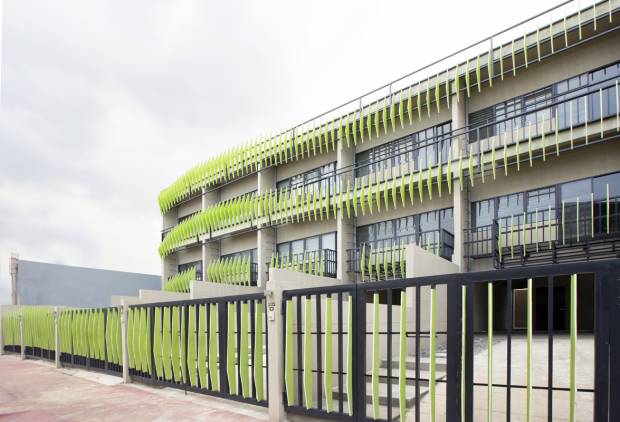
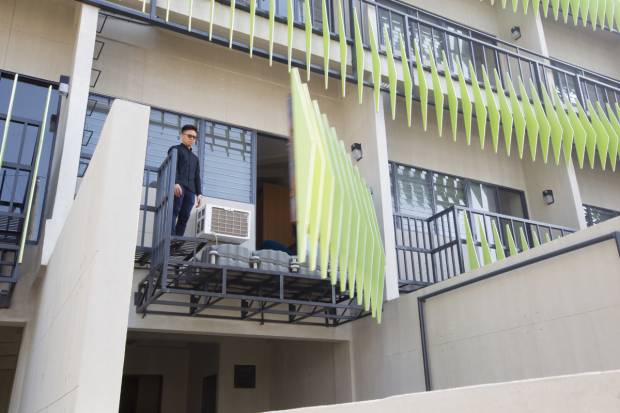
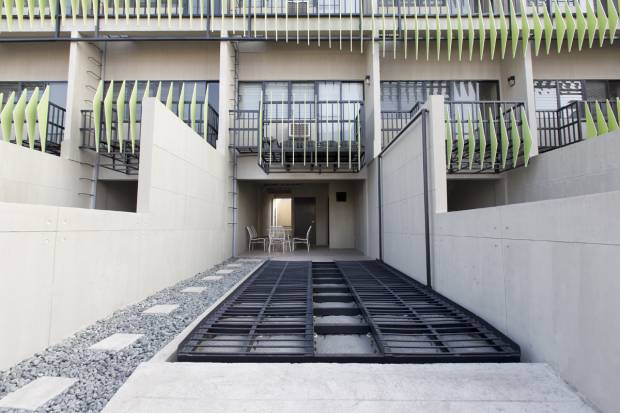
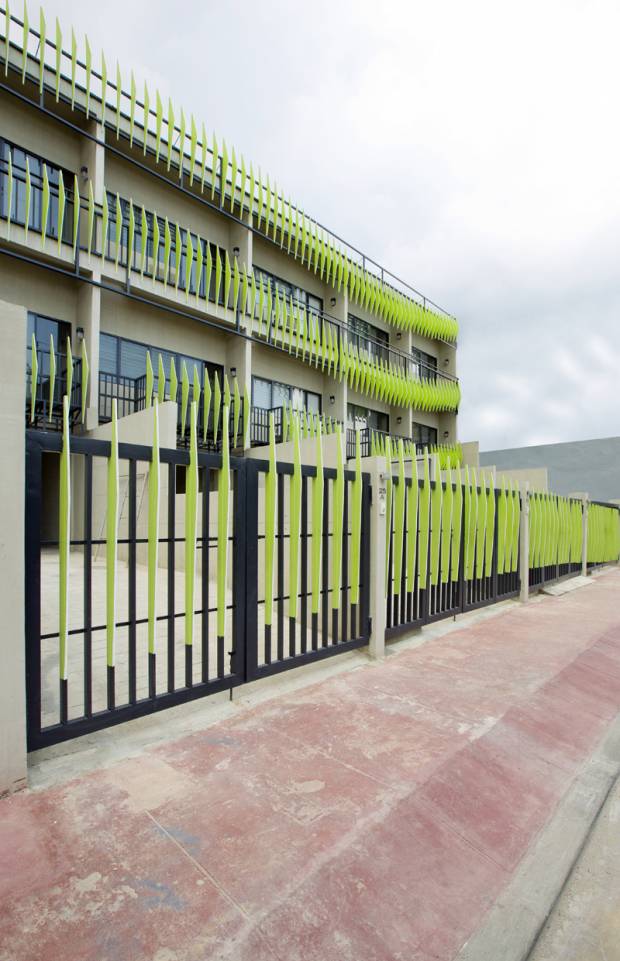
This week has been such a great week for us, specifically for ‘The House” Project, an interior job that we recently completed which happens to be situated in a townhome complex which we also designed. It first came out in trendhunter.com, one of the widely read website that focuses on whatever is the latest on art and design.

Link to ‘The House” Project on Trendhunter.com

'Constellation-Clad Condos', as seen in trendhunter.com

A few days later, it also popped up in Contemporist.com, a leading website when it comes to modern interior, funiture, and architectural design. Though some of our work have already been featured there (Courtyard House, Via Venetto)   we were still so excited to see ‘The House’ Project on this site as it has become a culmination of all our principles and beliefs about how to contemporize Filipino Architecture. Check out the link below:

Link to article in Contemporist.com

Contemporist.com!

One of our goals is really to put back our country in the design map of the world, and we believe that the only way to do that is to stick with our identity and stop trying to be someone else by always desiring archietcture from other countries. Filipino Architecture doesn’t have to be stuck to a literal bahay kubo or a literal copy of a bahay na bato, because there are infinite ways to make it adapt to modern times WHILE reflecting our identity and culture in it. If anyone noticed, NONE of the themed architecture here in our country (Mediterranean, Balinese, Greek, Victorian, etc) have been featured in international design websites. But as soon as there is something distinctly Filipino about the design, it automatically gets recognition – like how Bobby Manosa and Kenneth Cobonpue got international acclaim. That simply means that all we have to do is be honest with who we are, be proud of our identity, make our designs speak about it, and we will be recognized as a strong player in the global design industry.


THE STORY OF THE THE SYDNEY OPERA HOUSE

August 21, 2012

Text and Photos by Jason Buensalido , As seen in Urban Monologues, Business Mirror Newspaper (2007)


“Jorn Utzon, the architect of the Sydney Opera House, has never seen his masterpiece in the flesh since he left Australia in 1966.” said our animated tour guide. As if the design of the structure wasn’t interesting enough, I found out that the history of the building’s construction was even more colourful.

I recently took a trip to Australia where I felt like I was on another architectural pilgrimage. Any architect you talk to knows what the Sydney Opera House is, so it would be a shame if I didn’t see it with my own eyes. When I did, I didn’t realize that my jaw was dropped because the sight of the magnificent structure. It moved e, causing me to just stop and gaze in awe.

The idea of having an opera house in Sydney formed in the 940s, when a world-class visiting conductor came to the city to do a performance. He was able to talk to the city officials and told them that if they wanted to be a serious metropolitan, they needed to have a place where culture can flourish; they needed an opera house.

The visiting conductor probably hit an insecure nerve among the city politicians because after he left, they organized an international competition for the design of the Sydney Opera House. It was a very prestigious and high-profile competition, as over 200 entries were submitted from all over the world.

The entry of Jorn Utzon was already thrown in the trash can. Majority of the judges said that it was too different and too bold to be the new face of Sydney. Luckily, there was one judge who came in late and saw the entry in the can. He picked it up, spread it out, and showed it to once again to the other judges – “This should be our winner PRECISELY because it is different!”. Jorn Utzon, an unknown Danish architect, won 5000 dollars and the commission of the project. He moved his entire family to Australia and set up an architectural office there to oversee the construction of his work.

Originally, the budget for the opera house was 7-millon and the timeframe for construction was 7-years. What happened was it took 14 years to build, and about 102-million, which is about 1.2 billion today.

Naturally, the people of Sydney reacted during the course of construction. They started complaining that their tax money was being spent unnecessarily to build an opera house that they didn’t need in the first place. “We’re laid back people. We’re a country who loves the outback! We don’t need no opera house !”, I can almost imagine them say back in the 50s. The officials, since they wouldn’t take he blame themselves, they blamed the architect, Jorn Utzon. They tried to take him out of the picture and cut him out from the team to the point that he wasn’t being paid his salary anymore. Finally, in 1966, Jorn packed his bags and went back to Denmark with his family, giving up the fight for his masterpiece.

When he did, an Australian architect was asked to take his place. The Australians didn’t know anything about designing opera houses, so they were sent around the world for three years to study the design of different opera houses. They finished the  opera house on October 20, 1973 and was opened by no less than Queen Elizabeth herself.

The design of the building is very interesting as well. When Jorn Utzon was conceptualizing for the competition, nothing was coming into his mind. Luckily one morning, he was simply peeling an orange when he realized that the forms of his design could actually be derived from his breakfast! He then cut different triangular shapes from the orange’s sphere and put it together to come up with the final design of the opera house, calling it his ‘spherical solution’. Maybe architects should eat while designing too. You’ll never where you might get inspiration from.

The design of the Sydney Opera House was derived from triangular sections of a sphere. The architect was eating an orange one morning when he suddenly thought of a ‘spherical solution’.

The Sydney Opera house is consisted of three sail-like structures sitting on a podium. The smallest structure is a restaurant, and then the two are performance halls. The sails have a very modern sculptural quality and it makes you wonder how they were able to put together a structure as complicated as that way before computers. The sails are made of pre-cast panels held together by tension rods throughout the hollow portions of the structure. They say that the opera house has more steel than the Sydney Harbour Bridge nearby. The structure was actually put together like LEGO, the famous toy product which incidentally is from Denmark as well.

One would think that the exterior of the performance halls were purely white. But upon closer inspection, I found out that it is finished with tiles with 3 shades – off-white, cream, and beige. This makes sense because if it were too white, the structure would be too glaring. The tiles are triple glazed, which made the opera house one of the first self cleaning buildings in the world. The dirt from its surfaces simply creeps down to the drains whenever it rains. Meant to look like giant fish scales, Utzon got his inspiration form Moroccan buildings which are usually clad with tiles.

The surfaces of the opera house are clad with tiles of 3 shades – off-white, cream, and beige. The tiles are triple glazed, which made the opera house one of the first self cleaning buildings in the world. Meant to look like giant fish scales, Utzon got his inspiration form Moroccan buildings which are usually clad with tiles.

The first among the two performance halls is fondly called the black theatre because of its interiors, and is the smaller one between the two. It is an opera and a ballet theatre, with a backstage that can be lowered two levels down. That is where the sets are changed, since the space on the stage level is too small. In reality, there are a lot of flaws in the black theatre, and that is why it is due for a renovation soon, with a budget of 500 million.

Then we proceeded to the bigger performance hall. I thought that I had my share of awe that day, but I was further moved by the design of the interiors of the second hall. It had a soaring ceiling with a shape that seems to spring from the ground, changing and morphing into different configurations as it goes up. Unlike the other theatre, this one doesn’t have a proscenium. There are seats even at the back of the stage. There is no need for microphones during performances at this theatre because the combination of hardwood and softwood used for the interiors bounce all the sound coming from the stage back to the audience. The organ is equally impressive. It is the biggest mechanical organ in the world. It has about 140 pipes, took 10 years to build, 2 years to tune, and cost about 3 million dollars.

The three sail-like structures sit on a podium. Utzon got his inspiration form a typical Mayan temple, where you climb up a long set of stairs to get transported into a different world. In the same manner, going up the stairs of the podium was meant to symbolize your transportation to a world of art and culture, leaving the stresses of urban life behind. The heaviness of the podium also complements the lightness of the sails. This is where all the service spaces such as the practice stages and studios are housed.

The interiors of the big performance hall had a soaring ceiling with a shape that seems to spring from the ground, changing and morphing into different configurations as it goes up. The author fulfilling one of his architectural pilgrimages

I guess every high-profile structure has its own story. The Eiffel tower and the triangular entrance the Louvre was loathed by Parisians. The Statue of Liberty was rejected by the Americans when it first arrived. The Guggenheim Museums, both in New York and Bilbao, received endless negative criticisms. Now, all these structures are weaved seamlessly into their respective cities. They now stand as the foremost symbol for the people that once rejected them, just like the Sydney Opera House.

“The House” in Philippine Star, August 11 2012

August 19, 2012

We designed a series of townhouses for DMCI Homes and VConsunji Inc way back in 2009. The Sofia Townhouse, as it was called, was so successful that it was dubbed the “most beautiful townhouse in the Philippines” by some websites.

See design in these links:

http://www.dmci.bobonbeachresort.com/mahogany-place-3-taguig/

http://www.buensalidoarchitects.com/projects/sofia-townhomes-dmci-homes/

Perhaps that was because in 2008, Buensalido+Architects bagged the first prize in a national competition called “Ang Pinakamagandang Bahay Sa Balat Ng Lupa” (The Most Beautiful House on the Face of the Earth) against over 40 other architectural firms.

The interiors for this townhouse is a tribute to the Filipino spirit. As we constantly push for contemporary Filipino architecture, we found the aesthetic expression of this design intent through triangles, an abstracted representation of banderitas (or flaglets) that one would commonly see in local fiestas and festivals. As a country, the Philippines has one almost every day.

The Living Area

The Dining Area

The Deck, with the Fort Global City Skyline

It is a manifestation of the Filipino’s optimism and positive outlook in their lives, always knowing how to smile no matter how bad their situation is. This was captured with the different bursts of colors within the house, achieving a sense of vibrancy, festivity, and positivity.

These conceptual ideas were physically implemented in a contemporary and innovative way: the banderitas and triangles on the interior surfaces were achieved with a CNC milling machine, therefore attaining precision in its production and avoiding human error. Light fixtures were located above the cutouts, creating an ever-changing pattern of shadows, depending on how many lights are turned on. A certain kind of material honesty was aimed for, so for the concrete flooring for example, was kept as is, applying a special kind of lithium-based sealant to achieve a smooth, terrazzo-like effect.

THE HOUSE was featured in the Philippine Star, a national daily broadsheet in the Philippines, in it’s Modern Living section. Tanya Lara captures the story of the owners and interiors of the house in her article, Crazy Quilt.

Online version here - http://www.philstar.com/Article.aspx?articleId=836712&publicationSubCategoryId=85

Thank you so much Tanya, and to the Philippine Star! :)

page 1 of philippine star, modern living section

full spread - first half

full spread - second half


Kenji-Tei Greenbelt 5 at BluPrint May 2012

May 4, 2012

BluPrint Magazine, one of the firm’s favorite magazines, features Kenji-Tei Greenbelt 5 in their Interiors section. The shoot and interview were done simultaneously a few months ago with Asst. Editor Gaby Alegre, photographer Ed Simon (who took the spectacular twilight photo of our chapel project  in Batangas that made the cover of BluPrint as well), and Jim Caumeron. Ken Kho, our friend, maverick restaurateur and owner, was of course there as well.

We had to schedule it at 730 in the morning because everybody’s schedules wouldn’t meet and that was the only time everyone could be there at the same time. It actually worked well especially for the shoot because the reflections of the other store’s signages weren’t visible in our storefront shot, and the morning light penetrated the interiors beautifully.

Here’s how the feature looks like:

Some process diagrams and original renderings of the ramen house:

original renderings - showing dining space and function area

original rendering - dining area towards sushi bar

Thanks again BluPrint! Grab a copy now! Try the food too, especially their cheese gyoza, curry ramen, and the spicy negi ramen! Cheers!

ISLA PALMA @ Jardin De Miramar – under construction

April 18, 2012

Jardin De Miramar is a three-hectare complex in Antipolo that houses multiple garden-like venues for parties, weddings, events, and different functions. Among these unique venues are an outdoor space with a re-constructed 50-year-old fishing boat, a replica of Intramuros (where a lot of pre-nup photoshoots are held), a bahay kubo-inspired thatched pavillion, and Casa Santa – a museum of over 3000 Santa Claus figurines and statues. Within the complex are artwork by the likes of Ed Castrillo, Michael Cacnio, and Reg Yuson.

We were commissioned to design its newest event venue that would hold about 300 – 350 people and would revolve around a swimming pool to create a water-themed structure.

The first time we visited the site, we were struck by  two main things: the vertical rhythm that the coconut trees on site made, and the ever-changing pattern of shadows that their foliage created. We used these cues from nature to give shape to our structure. Dubbed as an “eco-tectonic imprint”, our proposed pavilion simply became an architectural translation of emergent patterns of nature that moved us as we absorbed the characteristics of the place.

perspective of ISLA PALMA

aerial view - showing pavillion, pool, and gazebo

view from poolside

view of interiors

San Vicente

March 31, 2012

As seen in Urban Monologues, Business Mirror Newspaper, Text by Jason Buensalido (July, 2007)


Just when I thought that developers, planners, and architects didn’t have a chance to correct the mistakes they made in developing Boracay, that’s the time an opportunity presented itself. I, together with another architect, was invited by a prospective client to accompany him to an ocular inspection of his property in San Vicente, Palawan, which he was thinking of developing into an exclusive beach resort. I have been to Palawan before, but I have never been to the San Vicente area, which is why I packed my bags right away and agreed to go with him without any hesitation.

San Vicente is one of the many municipalities in Palawan and is located on its north-western side. It is bounded on the west by South China Sea, the municipalities of Taytay, Roxas, and Puerto Princesa on the north, east, and southwest; respectively. About 75% of it is generally forested, which allows the place to have a rich marine, agriculture, and forest resources endemic only to Palawan. It also has a pearl farm of about 8 hectares. But what impressed me most was the endless stretch of pristine and untouched white beach! Boracay is 7 kilometers long but only has a white beach that is about 2.5 kilometers. Imagine the beach in Boracay, multiply it sixteen times, and you’ll get an idea of how long the beach is in San Vicente because it runs a stretch of over 40 kilometers collectively! Now that’s what you can call a slice of paradise! During low tide, the beach can be as wide as 60 meters from the first line of coconut trees to the tip of the water. I could start to imagine the different recreational activities that you can do with a beach as wide as that. We visited the different parts of the long beach such as Alimanguhan, Maymanoc, Lion’s Head, Canefo, Luambong, Port Barton, and Exotic Island to name a few. From anywhere in the long beach, we enjoyed beautiful views of the open ocean, Mt Capwas, and the sunset.


San Vicente has a long beach of over 40 kilometers long

60 meter-wide beach

Being in an untouched and undeveloped municipality was very interesting. I was able to witness a number of ‘vignettes’ or ‘snapshots’ that describe the simplicity of the place. In the mornings and afternoons, all the kids of the town would walk kilometres to get to and from school. It would take them so long to get home that some of them would do their homework while walking, so that by the time they get home, they would be finished with their assignments. I also saw how some of them catch fish. The process is called ‘pangangawil’, where they use about a three hundred meter fishnet. One end of the net is left on shore, while the other end is pulled by a boat out into the open sea. The net is then brought back to the shore, forming an arch in the ocean. The two ends are then pulled by the whole community, little by little, until the entire fish net is brought back to shore. Some days, they fill up three baskets with different fish; some days, they don’t catch anything. The owner of the fishnet then divides the catch of the day into two. The first half is sold to local markets or is exported to other towns while the other half is given to the community as their food for lunch or dinner, making everybody happy.  I was deeply moved by how their community works together daily to achieve even a small task of catching fish. Even if they have simple lives, I didn’t see a face that didn’t have a smile on it.

Another thing that made my visit to San Vicente paradise-like was the food. We stayed in ‘Caparii’, which was originally a scuba camp that was converted into a small resort complete with a dining hall, VIP suites, and function rooms. Throughout our stay, we would constantly joke around and call it the ‘fattening farm’, because it seemed like there was something in the food that made you want to eat more with every bite. Some of the food served was a soup that was a cross between lobster chowder, stuffed crab, chicken curry, and lapu-lapu. There were some vegetables that were endemic to Palawan. For dessert, they would serve this fruit called ‘champada’, a cross between marang and langka, whose seed they brought from Indonesia.

Developers and private investors are starting to see the development potential of this area. I am sure that San Vicente will be a ‘beach resort town’, ushering in a huge influx of local and foreign tourists. My only hope is that the investors, architects, and planners who will be coming in to prepare their respective designs will take into consideration the mistakes made in the famous Boracay. Environmental issues have to come first to ensure that this jewel of a beach will not deteriorate over the coming years. Proper setbacks from the beach front should be maintained and the architecture should be carefully designed so as not to seem too ‘imposing’ on the natural beauty of the place. For sure, there will be huge requirements for different resorts to be able to thrive in a beach strip as long as this. This is why alternate sources of energy should also be integrated in the preparation of plans. An updated development plan should be prepared to serve as a non-negotiable guideline for future developers. The local government and our tourism groups should form partnerships to enforce such plans and to ensure correct developmental procedures. I do hope that this time, nobody repeats the same mistakes.

A unique fruit called ‘champada’

Island hopping with Arch. Gelo Mañosa and Chet Pastrana


The Urban Zone Story

March 31, 2012

Urban Zone was an iconic show on TV which featured well-designed homes and other spaces as well as the architects and owners responsible for their beauty. Hosted by Daphne Osena-Paez, it became a much sough-after and inspiring show for “Urbanistas”, and a platform where architects and designers like us could share our projects and design sensibilities. The show stopped airing on TV a few weeks back, and Buensalido+Architects’ Icon(‘s) Penthouse luckily caught the tail end of the show. It was truly an end of an era.

But as they always say – “When God closes a door, he opens a bigger one”. True enough, just yesterday, Daphne posted a video on her blog announcing that UZ will air in a new form. Its coming back with a bang thru her website - http://daphne.ph/ as webisodes!

We’re all excited for this as now, we can watch the show anytime, on our own schedule. We think that this is really a great move as it will now have a wider reach – time-wise, geographically, and socially. A true democratization of design. Kudos to you, Daphne!

Sharing with you guys her video, as seen in Daphne.ph. Enjoy!


Slivers Magazine – Issue 1, Volume 12, March 2012

March 28, 2012

As featured in Slivers Magazine.

Special Thanks to Paolo Navarra for the photos and the the editorial team of Slivers.

Cover Page


Feature on Kasoy House.


Feature of Project C

Click on the gallery below to see the rest of the feature! enjoy!

Photo Credits:

Paolo Navarra for Architecture and Interiors

Oly Ruiz of MetroPhoto for Profile